quarta-feira, 29 de fevereiro de 2012

O que ninguém jamais teria sonhado


Ora, eis que encontrando cristãos, observando-os viver – e morrer –, conversando com eles ocasionalmente, pressentia-se como que outro modo de ver, de se ver, de ver os outros, e de entrever o divino. Embora os primeiros cristãos não sejam todos virgens e mártires, aos olhos dos pagãos alguma coisa chegava a dar inveja. Havia entre aqueles cristãos como que uma presença que eles eram os únicos a sentir. Uma presença que lhes inspirava o comportamento, não apenas religioso. Mesmo entre eles, as relações pareciam diferentes. Como se nunca estivessem sozinhos. Como se aquela presença acompanhasse a todos e cada um ao longo dos seus dias e, a dar-lhes crédito, para além da morte e por toda a eternidade. Certamente, os cultos de mistério já prometiam a imortalidade, mas, naquele caso, sentia-se algo de mais íntimo; uma proximidade incomum para um deus. Havia, porém, outra coisa. A se acreditar nos cristãos, Christus se assimilara aos humanos como nenhum outro deus até então. Um de seus textos dizia: Ele plantou sua tenda entre nós, eskénosen en emìm. Assim, e isso era inconcebível, o deus Christus se fez homem a ponto de assumir o sofrimento e a morte – e em que condições! E mesmo que não o compreendessem muito bem, as pessoas descobriram, maravilhadas, que para aquele deus um ser humano importava. A vida de cada um recebia, de repente, um significado eterno no interior de um plano cósmico. E como era assim para todos e cada um, a ideia de fraternidade ganhava forma, concretizando a abstrata philantropia dos sábios. A ideia de um deus de amor implicava a de um amor sem fronteiras. Pois, com o Cristianismo, a devoção mudou de natureza. Não era mais uma questão de ritos a serem cumpridos em momentos determinados; as pessoas não se safavam mais com uma vítima, ou com um pouquinho de incenso nas brasas. Era a si próprio que se tinha de sacrificar como Christus se sacrificara. Era preciso oferecer-se ao deus, e também aos outros, que se tornaram igualmente irmãos para serem amados como a si mesmo. Nada fácil, mas pertubador. Tudo isso, com o que ninguém jamais teria sonhado, tinha por que fascinar.

[Fonte: Luc Ferry e Lucien Jerphagnon, A tentação do Cristianismo: de seita a civilização. Editora Objetiva, 2011]

Lido em Ed René Kivitz.

Cristãos dos quais não me envergonho: Antônio Gouvêa Mendonça

Antônio Gouvêa Mendonça (1922-2007)

O professor fala sobre si.

História de Vida. Antonio Gouvêa Mendonça por ele mesmo

Homenagens a Antônio Gouvêa Mendonça.

Honra ao mérito. Homenagem na despedida da Universidade Metodista de São Paulo (5 de agosto de 2002)

Texto escrito por ocasião de sua morte.

Um protestante ecumênico

terça-feira, 28 de fevereiro de 2012

Entrevista do reverendo Aldo Quintão


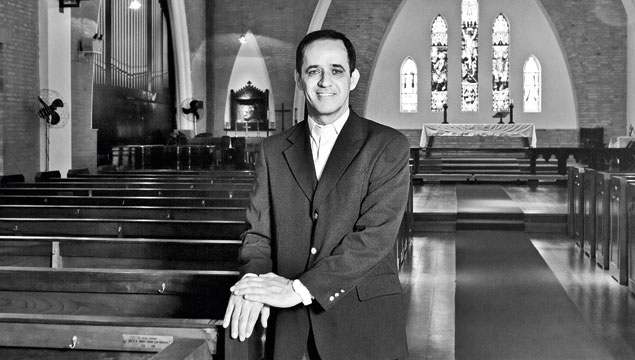
Dizem que o reverendo Aldo Quintão, 49, é polêmico. "Não é bem assim. Sou contemporâneo", diz ele, que é casado há 23 anos e tem um filho de 22.

Na Catedral Anglicana, em Santo Amaro, zona sul, o brasiliense conquistou fiéis com um discurso sem restrições. O direito ao aborto e o respeito aos gays estão na pauta.

O padre, em São Paulo desde 1984, já celebrou mais de 3.000 casamentos. Para este ano, não há vagas nos dias mais procurados, sextas e sábados.

Maria do Carmo/Folhapress     

O reverendo Aldo Quintão, 49, da Catedral Anglicana de São Paulo, já celebrou mais de 3.000 casamentos

Qual é o maior pecado paulistano?
O individualismo, que se traduz na insensibilidade diante dos dramas sociais. Precisamos de mais solidariedade. Parece óbvio, mas é muito difícil encontrar isso em uma cidade como São Paulo.

Por que dizem que o sr. é liberal?
Talvez porque debato questões polêmicas e defendo minorias. Temas como o direito ao aborto, os estudos com células-tronco, o respeito aos gays e o uso de anticoncepcionais devem ser abordados. Quero discutir o que é o mundo contemporâneo --e não o que é a igreja.

São Paulo é uma cidade liberal?
Por um lado, é liberal. É uma metrópole gigante, que garante o anonimato. Por outro, é conservadora nas relações entre conhecidos. Somos liberais enquanto cidade e conservadores enquanto família.

Quem frequenta a Igreja Anglicana?
Todos são bem-vindos. Inclusive gays assumidos, divorciados e fiéis desiludidos com outras religiões. O mundo moderno é marcado por uma sociedade plural. Na minha leitura do Evangelho, todo mundo tem o direito de ser feliz. Aqui, as pessoas sentem que as diferenças são respeitadas.

Quais foram os casamentos mais marcantes que realizou?
Foram dois extremos. Um foi a união de dois amigos de infância, num rancho em Pindamonhangaba (SP), onde brincavam quando crianças. O outro foi o casamento do cantor sertanejo Bruno, no Terraço Daslu. Adoro música sertaneja. De repente, vi que estava celebrando uma missa para Chitão- zinho, Daniel e Michel Teló. O próximo noivo famoso é o cantor Paulo Ricardo.

Quantos casamentos já celebrou?
Já fiz mais de 3.000 casamentos, 90% em São Paulo. Casei evangélicos, hindus, judeus, muçulmanos, grávidas, desquitadas e por aí vai. Casamento gay? Farei assim que a lei permitir.

Fonte: Folha.

segunda-feira, 27 de fevereiro de 2012

Discussão Teológica


De vez em quando leio comentários de cristãos nas mídias sociais dizendo, "eu sou mais a Bíblia, eu só quero Jesus, esse negócio de discussão doutrinária só divide a igreja, é coisa de homem e do diabo".

É claro que eles estão certos se a discussão doutrinária for movida por interesse mercenários e pela luta pelo poder. Todavia, este tipo de juízo generalizado revela uma falsa piedade enorme e uma ignorância ainda maior.

Se hoje estes queridos têm a Bíblia no Brasil para ler em português e conhecem o Jesus que ela ensina é por que:

A Igreja reconheceu os 66 livros somente depois de muita polêmica contra Marcião e Montano no séc. II a III; sem isto, nem Bíblia teríamos ou então, uma mutilada;

Os Reformadores quebraram o pau na Idade Média para dizer que a Bíblia é a revelação final de Deus e com isto conseguir que ela voltasse para as mãos do povo;  sem isto, estaríamos escutando missa em latim até hoje e sem uma Bíblia em nossa língua para conferir;

Comitês de tradução brigam e disputam teologia para saber qual a melhor tradução do grego e hebraico para o português; imagino que estes irmãos "piedosos" não lêem nem grego e nem hebraico e que dependem do português para ler a Bíblia;

Teólogos e mestres crentes lutaram e brigaram contra os liberais para que as igrejas ficassem com o Evangelho puro acerca de Jesus, verdadeiro Deus e verdadeiro homem. Sem estas disputas teológicas, estaríamos reverenciando um Jesus diferente daquela da Bíblia.

Portanto, acho que estes irmãos estão simplesmente cuspindo no prato em que comem todo dia, ao condenar as disputas teológicas ao mesmo tempo que lêem sua Bíblia em português.

Apesar de discordar de muitas posições de Augustus Nicodemus, ele tem toda a razão em afirmar a importância da discussão teológica.

Medíocres Torquemadas


Por Mauricio Dias

As igrejas, sempre de costas para o futuro, continuam intolerantes às renovações. No tempo do domínio católico no Ocidente, os contestadores de falsas verdades eram atirados à fogueira, amaldiçoados pela Inquisição, que não dava trégua a supostas heresias.

Nos dias de hoje, impotentes para ditar condenações capitais, os inquisidores ordenam aos fiéis a punição de políticos que defendem propostas dissidentes à doutrina que pregam. O aborto e a defesa da homofobia são os exemplos mais gritantes. E irritantes. Em reação, eles promovem nas eleições a “queima” de votos dos hereges e, com isso, cerceiam a liberdade do eleitor e intimidam os candidatos.


Assim agem os pregadores das igrejas evangélicas. São os novos inquisidores.

Essa réplica tardia e infeliz do Tribunal de Inquisição materializou-se no Congresso, onde foi depor o ministro Gilberto Carvalho, na terça-feira 15 de fevereiro. Carvalho, secretário-geral da Presidência da República, viu-se forçado a expiar publicamente “pecados” cometidos aos olhos da poderosa bancada evangélica, transformada em braço executivo de diversas igrejas religiosas.

“O pedido de desculpas, de perdão, não foi pelas minhas palavras, e sim pelos sentimentos que provocaram”, disse o ministro.

Qual foi a heresia? Gilberto Carvalho, durante o Fórum Social Mundial, manifestou preocupação política com os evangélicos: “A oposição virou pó (…) a próxima batalha ideológica será com os conservadores evangélicos que têm uma visão de mundo controlada pelos pastores de televisão”.

Carvalho é católico fervoroso, mas também é militante político. Petista. Em razão do cargo, não foi cauteloso, embora tenha falado ingênuas obviedades. Não pregou o cerceamento de qualquer manifestação religiosa. Mas foi o suficiente para despertar a ferocidade adormecida da Frente Parlamentar Evangélica, na qual se destaca o senador capixaba Magno Malta, que, entre outras ofensas, chamou o ministro de “irresponsável”.

Um parlamentar ateu presente ao encontro fechado à imprensa descreve assim o ambiente naquele dia: “Os olhos dos senhores parlamentares disparavam chispas de fogo, ódio, raiva e intolerância diante daquele enviado do Maligno que se tornara ministro (…). O clima era pesado. Aquela reunião e a Inquisição têm tudo a ver. Tenho certeza que não exagero. O problema para eles era não poder acender a fogueira. Restavam-lhes as línguas de fogo, prontas a queimar o demônio pecador”.

Serelepe, o deputado Anthony Garotinho, ex-governador do Rio e evangélico atuante, também se destacou na ocasião. Sem sucesso, tentou forçar o ministro a assinar um documento desmentindo as declarações publicadas, mas diferentes do que falou, garantiu Gilberto Carvalho. O inquisidor fez, pelo menos, uma declaração expressiva e inteiramente adequada ao ambiente criado.

“O perdão está para a Igreja assim como a anistia está para a política”, comparou Garotinho.

Igreja e política. O desempenho de Garotinho aproximou ainda mais aquela reunião no Congresso do espírito obscurantista assumido pelos evangélicos. Nesse sentido, fazem uma repetição tardia do catolicismo primitivo.

Os votos dos evangélicos, arma que usam no processo político, talvez não sejam eleitoralmente decisivos. São muitos, é certo. O suficiente para acuar candidatos em busca de votos. Com eles acuaram Dilma e Serra, na eleição de 2010, e transformaram a competição em espetáculo para exibição de medíocres Torquemadas.

extraído de Carta Capital.

Os fantásticos livros voadores do Senhor Morris Lessmore

Assista o curta-metragem ganhador do Oscar 2012, The Fantastic Flying Books of Mr. Morris Lessmore.


quinta-feira, 23 de fevereiro de 2012

A integridade do evangelho: uma avaliação do neopentecostalismo


Por Alderi Souza de Matos

Elas ocupam um enorme espaço na televisão aberta, chegando a milhões de lares brasileiros todos os dias. As três mais conhecidas e salientes têm nomes parecidos — Igreja Universal do Reino de Deus, Igreja Internacional da Graça de Deus e Igreja Mundial do Poder de Deus. Esses nomes apontam para objetivos ousados e ambiciosos. Seus líderes máximos adotam, respectivamente, os títulos de bispo, missionário e apóstolo. Elas são o fenômeno mais recente, intrigante e explosivo do “protestantismo” tupiniquim. Trata-se das igrejas neopentecostais, denominadas por alguns estudiosos “pentecostalismo autônomo”, em virtude de seus contrastes com os grupos mais antigos desse movimento.

É difícil categorizá-las adequadamente, não só por serem ainda recentes, mas porque, ao lado de alguns traços comuns, também apresentam diferenças significativas entre si. A Igreja Mundial investe fortemente na cura divina. Seu apóstolo garante que ninguém realiza mais milagres do que ele. Seu estilo é personalista e carismático. Caminha no meio dos fiéis, deixa que as pessoas recolham o suor do seu rosto para fins terapêuticos, às vezes é ríspido com os auxiliares. O missionário da Igreja Internacional é simpático e bonachão; parece um pastor à moda antiga. É também polivalente: prega, canta, conta piadas, anuncia produtos e serviços. Controla com rédea curta o seu pequeno império. Todavia, nenhuma dessas igrejas vai tão longe na ruptura de paradigmas quanto a IURD. Dependendo do ângulo de análise, parece protestante ou católica. Seu carro-chefe é a teologia da prosperidade. Defende sem pejo a ética da sociedade de consumo. Seu líder está entrando na lista dos homens mais ricos do país.

Desde o início, o cristianismo tem exibido uma grande variedade de manifestações, algumas bastante inusitadas. Foi o caso do gnosticismo e do marcionismo nos primeiros séculos, das seitas apocalípticas na Idade Média e de alguns grupos resultantes dos reavivamentos nos Estados Unidos do século 19. Porém, nenhum movimento tem sido tão pródigo em termos de quantidade e diversidade de ramificações quanto o pentecostalismo contemporâneo. No atual ambiente pluralista e inclusivista, muitos observadores vêem nessa multiplicidade um sinal de vitalidade, de dinamismo. Todavia, há sinais preocupantes nos ensinos e práticas de certos grupos. Na célebre Confissão de Fé de Westminster (1647), os puritanos ingleses colocaram a questão em termos de diferentes graus de pureza das igrejas cristãs — cap. 25.4,5 (igrejas mais puras e menos puras). Uma avaliação simpática e honesta das igrejas neopentecostais aponta para alguns aspectos que precisam ser reconsiderados a fim de que elas se tornem genuínos instrumentos do evangelho de Cristo.

O problema hermenêutico

Uma grave deficiência dessas novas igrejas está na maneira como interpretam a Bíblia. Os reformadores protestantes insistiram no valioso, porém arriscado, princípio do “livre exame das Escrituras”, ou seja, de que todo cristão tem o direito e o dever de ler e estudar por si mesmo a Palavra de Deus. Acontece que muitos viram nisso uma licença para a livre interpretação do texto sagrado, o que nunca esteve na mente dos líderes da Reforma. Eles lutaram contra uma abordagem individualista e tendenciosa da Escritura, insistindo na adoção de princípios equilibrados de interpretação que levavam em conta o sentido literal e gramatical do texto, a intenção original do autor, o contexto histórico das passagens e também a tradição exegética da igreja. Por essas razões, eles rejeitaram o antigo método de interpretação alegórica, isto é, a busca de sentidos múltiplos na Escritura, por entenderam que ela obscurecia e distorcia a mensagem bíblica.

Em muitas igrejas neopentecostais nada disso é levado em consideração. A Bíblia se torna um joguete, uma peteca lançada para lá e para cá ao sabor das conveniências. Tomam-se diferentes declarações, episódios e símbolos bíblicos e, sem esforço algum de interpretação, passa-se diretamente para a aplicação, muitas vezes de uma maneira que nada tem a ver com o propósito original da passagem. O que é ainda mais grave, os textos bíblicos são usados de modo mágico, como se fossem amuletos ou talismãs, como se tivessem um poder imanente e intrínseco. A Bíblia é encarada prioritariamente como um livro de promessas, de bênçãos, de fórmulas para a solução de problemas, e não como a revelação especial na qual Deus mostra como as pessoas devem conhecê-lo, relacionar-se com ele e glorificá-lo.

Uma nova linguagem

Na sua releitura da Bíblia, os neopentecostais por vezes criam uma nova terminologia, muito diferente dos conceitos bíblicos tradicionais. Privilegiam-se expressões como “exigir nossos direitos”, “manifestar a fé”, “declarar a bênção”, todos os quais apontam para uma espiritualidade antropocêntrica, ou seja, voltada para as necessidades, desejos e ambições dos seres humanos, e não para a vontade e a glória de Deus. Alguns dos temas bíblicos mais profundos e solenes redescobertos pelos reformadores do século 16 são quase que inteiramente esquecidos. Não mais se fala em pecado, reconciliação, justificação pela fé, santificação, obediência. O evangelho corre o risco de ficar diluído em uma nova modalidade de auto-ajuda psicológica, deixando de ser “o poder de Deus para a salvação de todo aquele que crê”.

O conceito de fé talvez seja aquele que esteja sofrendo as maiores distorções. No discurso de muitas igrejas do pentecostalismo autônomo, a fé se torna uma espécie de poder ou varinha de condão que as pessoas utilizam para obter as bênçãos que desejam. Deus fica essencialmente passivo até que seja acionado pela fé do indivíduo. É verdade que Jesus usou uma linguagem que aparentemente aponta nessa direção (“tudo é possível ao que crê”, “vai, a tua fé te salvou”). Mas o conceito bíblico de fé é muito mais amplo, a ênfase principal estando voltada para um relacionamento especial entre o crente e Deus. Ter fé significa acima de tudo confiar em Deus, depender dele, buscar a sua presença, aceitar como verdadeiras as declarações da sua Palavra. O objeto maior da fé não são coisas, mas uma pessoa — o Deus trino.

Fundamento questionável

A teologia da prosperidade, que serve de base para boa parte da pregação e das práticas neopentecostais, é uma das mais graves distorções do evangelho já vistas na história cristã. Essa abordagem teve início nos Estados Unidos há várias décadas, sob o nome de “health and wealth gospel”, ou seja, evangelho da saúde e da riqueza. No neopentecostalismo, essa se torna a principal chave hermenêutica das Escrituras. Tudo passa a ser visto dessa perspectiva reducionista acerca do relacionamento entre Deus e os seres humanos. O raciocínio é que Cristo, através da sua obra na cruz, veio trazer solução para todos os tipos de problemas humanos. Na prática, acaba se dando maior prioridade às carências materiais e emocionais, em detrimento das morais e espirituais, muito mais importantes.

Tradicionalmente, as maiores bênçãos que o homem podia receber de Deus incluíam o perdão dos pecados, a reconciliação, a paz interior e, num sentido mais amplo, a salvação. Dentro da nova perspectiva teológica, as coisas mais importantes que Deus tem a oferecer são um bom emprego, estabilidade financeira, uma vida confortável, felicidade no amor e coisas do gênero. É uma nova versão da tese do sociólogo alemão Max Weber, segundo o qual os calvinistas buscavam no sucesso econômico a evidência da sua eleição. Os problemas da teologia da prosperidade são diversos: (a) falta de suporte bíblico — a Escritura aponta na direção oposta, mostrando a armadilha em que caem os que se preocupam com as riquezas; (b) empobrecimento da relação com Deus, concebida em termos interesseiros e mercantilistas; (c) incentivo a atitudes de individualismo, egocentrismo e falta de solidariedade; (d) tendência para a alienação quanto aos problemas da sociedade.

Conclusão

O neopentecostalismo representa um grande desafio para as igrejas históricas e mesmo para as pentecostais clássicas. Esse movimento tem encontrado novas formas de atrair as massas que não estão sendo alcançadas pelas igrejas mais antigas. Nem todos os grupos padecem dos males apontados atrás. Muitas igrejas neopentecostais são modestas, evangelizam com autenticidade e não se rendem à tentação dos resultados rápidos, dos projetos megalomaníacos e dos métodos incompatíveis com o evangelho. O grande problema está nas megaigrejas e seus líderes centralizadores, ávidos de fama, poder e dinheiro. Estes precisam arrepender-se e voltar às prioridades da mensagem cristã, buscando em primeiro lugar o reino de Deus e a sua justiça, para que então as demais coisas lhes sejam acrescentadas.


• Alderi Souza de Matos é doutor em história da igreja pela Universidade de Boston e historiador oficial da Igreja Presbiteriana do Brasil. É autor de A Caminhada Cristã na História e Os Pioneiros Presbiterianos do Brasil.

Descoberto em Ultimato.

Tradução e traduções da Bíblia no Brasil

Tradução e traduções da Bíblia no Brasil

Cristãos dos quais não me envergonho: Karl Rahner


Karl Rahner (Friburgo em Brisgóvia, 5 de março de 1904 — Innsbruck, 30 de março de 1984) foi um sacerdote católico jesuíta de origem germânica e um dos mais influentes teólogos do século XX. Participou como teólogo do Concílio Vaticano II. Além disso, criou a revista Concilium e escreveu mais de 800 artigos e ensaios.

100 anos de Karl Rahner

quarta-feira, 22 de fevereiro de 2012

Deus é de direita ou esquerda?

Acompanhe o debate entre Denis Müller (professeur d’éthique aux universités de Genève et Lausanne), Dominique Froidevaux (directeur de Caritas Genève) e Claude Ruey (conseiller national libéral).


Fonte: TSR.

La tentation autoritaire du christianisme


Nous vivons une crise généralisée, et la tentation est grande, en politique comme en économie, de proposer des remèdes de cheval. C’est le propre des esprits autoritaires ou démagogiques de faire appel à l’ordre et à la discipline. Les Eglises n’échappent pas à cette illusion. Le protestantisme, en particulier, cultive la liberté d’opinion et d’expression, le pluralisme démocratique et théologique, la controverse à la loyale, la disputatio, comme on disait au Moyen Age. Mais il y a un minimum de règles: savoir de quoi on parle, accepter d’être contredit, ne pas prendre son opinion pour Parole d’Evangile.

Un seul exemple: l’ouvrage «Turbulences. Les Réformés en crise». Sous couvert de proposer une nouvelle Réforme, ce livre cite les auteurs à la hussarde et en appelle à un conservatisme sévère, en doctrine comme en morale. Retour à la discipline, retour à l’orthodoxie! Les deux pasteurs semblent vouloir exercer un magistère que ne leur confère pas d’office leur beau ministère. Ils distribuent bons et mauvais points, sans respect pour le contexte où tel propos a été tenu. On s’étonne qu’un tel manuscrit n’ait pas été revu et rectifié par un comité de lecture! Son retentissement n’est pas en soi le gage de qualité scientifique, et son appel légitime à une nouvelle spiritualité n’excuse pas tout.

Des voix se font entendre, fort heureusement, pour relever les erreurs de ce livre, déplorer son esprit chagrin, refuser sa posture réactive. En clair: les Eglises réformées et tous les chrétiens – la société tout entière, finalement – méritent mieux que ce moralisme austère et cette théologie autarcique. L’Evangile me paraît offrir des pistes spirituelles et éthiques plus généreuses et mieux adaptées, qu’un rétroviseur mal poli et mal placé nous empêcherait de saisir et de suivre.

Texto de Denis Müller.

On Jesus’ Choosing Twelve Men


J. R. Daniel Kirk (PhD), New Testament professor at Fuller Seminary Northern California, is an author, and he blogs daily at Storied Theology (http://jrdkirk.com). He will be speaking in April at the CBE Houston Conference, “A New Creation. A New Tradition: Reclaiming the Biblical Tradition of Man and Woman, One in Christ.”

In last week’s Arise, I responded to John Piper’s description of Christianity as a “masculine” religion.

Today’s issue has to do with the significance of Jesus’ choosing of twelve men to be his disciples. This is one of several issues I take up in Jesus Have I Loved, but Paul?. The story within which this selection of the twelve is embedded leads us to draw a very different point from Piper’s.

Jesus chooses twelve men. These twelve Jesus specially commissions. Jesus came preaching, casting out demons, and healing. The disciples are sent to preach, heal, and cast out demons.

Jesus comes proclaiming and inaugurating the reign of God, and these men are sent out to participate in that coming. When Jesus feeds the 5,000, he hands the bread to them. They are the chosen. They are the insiders.

In contrast (let’s stick to Mark’s Gospel here), the women in the story are marginal. There are small handfuls of nameless women. They touch Jesus’ robe, they ask for healing for their daughters, they throw a few coins in a box in the temple, they anoint Jesus’ head with oil.

So while the women are coming in and going out, acting on faith and finding praise for their faith, it’s the boys who are getting it done!

Getting it done, that is, right up until the great, transitional moment in the story.

“Who do you say that I am?” asks Jesus. “You are the Christ.” Ok, so far so good. Then, Jesus begins to tell them what this title entails: “The Messiah must be rejected, suffer, and die. Then he’ll be raised.”

Peter rebukes Jesus. Jesus rebukes him back: “Get behind me Satan.”

What happens then? Move on to chapter 9, and the disciples who had been empowered to exorcise are unable to cast out a demon. The disciples who had been given the charge to proclaim cannot overcome the mute-making spirit.

Later in that same chapter Jesus again predicts his death. The disciples’ reaction? They walk along debating with each other about who is going to be greatest in God’s coming kingdom.

We begin to see what they don’t get about Jesus’ ministry: the cross turns the economy of the world on its head. They have a standard of greatness that entails a certain kind of leadership and power, but Jesus wants to transform their ideas. He wants them to see greatness in the cross and in the child.

As if Mark, or Jesus, thought we might miss the point, we get the whole thing a third time.

Jesus predicts his death, and this time the subsequent response of the disciples is James’ and John’s request to sit at Jesus’ right and left hand. Again, Jesus has to combat not merely the request, but the wrongheaded assumption about what greatness in the kingdom of God looks like:

“Jesus called them over and said, ‘You know that the ones who are considered the rulers by the Gentiles show off their authority over them and their high-ranking officials order them around. But that’s not the way it will be with you. Whoever wants to be great among you will be your servant. Whoever wants to be first among you will be the slave of all, for the Human One didn’t come to be served but rather to serve and to give his life to liberate many people’ (Mark 10:42-44, CEB).”

In the story, the disciples do not understand what is entailed in leading the people of God. They think it is about greatness and power rather than service and death.

The twelve were committed to Jesus, and happy with him–but only as one who came with power. They lacked faith to participate in his way of death. They did not have eyes to see that the ministry of Jesus turned the economy of the world on its head.

Shall we return to the women now?

How are we to assess these women who, in the narrative world, are outsiders, on the margins?

Unlike the disciples who are rebuked for being of little faith, Jesus commends the nameless, bleeding woman for her belief: “Daughter, go in peace, your faith has made you well.”

Moreover, there is one episode where Jesus ties a human inseparably to the gospel story. It is the episode of the woman who pours oil over Jesus’ head. This looks to be a royal anointing! But when Jesus defends her he says, “Leave her alone, she has prepared my body beforehand for burial.”

The act of anointing prepares Jesus for burial: Messiahship and death are held together, and here is the only person in the whole story to get it. This is why “wherever the gospel is preached what she has done will also be told in memory of her.”

What does it mean to live at the margins, to be unnamed? How does this compare with being the twelve, the guys, the insiders?

According to the economy of the world, with its measures of greatness, to be the twelve is to be exemplary, in the place to lead, to exclude others from leadership, to stand close to Jesus and guard the gates of who else can draw near.

And to the extent that we look to Jesus’ selection of them, and the apparent marginalization of the women, as paradigmatic for male leadership in the church, we show ourselves to be people whose minds have not yet been transformed by the very story to which we are appealing.

It is only by agreeing with the disciples’ way of assessing the world that we can see their “insider status” as a true insider status, to be replicated by other men in church history.

Jesus offers another way: You guys don’t get it! It’s the rulers of the Gentiles who lord authority over people. It shall not be so among you.

There is another way. It is the way of the cross.

There is another way. It is the way of the “marginalized” in the world’s eyes lying closest to Jesus in faith and understanding.

Are we really supposed to hold up as our model the “Satan” who denied the gospel of the crucified Christ, and claim that Peter is paradigmatic of the place of men as insiders and faithful leaders in the church?

Or should we not seek out the one who did the good deed for Jesus, holding together Messiah and death from her place at the margins? Should we not seek out the one who sought out Jesus merely to touch the fringe of his garment and learn from her what it means to walk in faith?

The irony of appealing to the boys as insiders is that in so doing we show ourselves to be adopting the boys’ understanding of power, privilege, and leadership in the kingdom.

And this view is roundly rebuked by Jesus in words of dissuasion and the work of the cross.

Diretamente de Jesus Creed.

Confessions d'un pasteur tout neuf


Au milieu des turbulences de l'Eglise, il avoue savoir encore se réjouir ! Nous avons une réforme spirituelle à vivre avant tout, mais pas plus aujourd'hui qu'une autre fois, affirme ce jeune pasteur vaudois. Il prend la plume.


Par Dimitri Juvet

Je suis un pasteur tout neuf. Il y a seulement quelques années, j'étais encore, avec mes collègues d'étude de théologie, dans le bureau du pasteur Pierre Glardon (lire ci-dessous) pour envisager les démarches qui nous conduiraient au ministère pastoral. « Nous avons besoin de ministres solides ! » C'est ce qu'il a commencé par nous dire.

Solides, nous l'avons été, pour passer successivement les étapes du Master en théologie, des examens d'entrée en stage, du stage et de son évaluation, et enfin des examens de consécration.
Aujourd'hui, le message de Pierre Glardon est le même : nous sommes en crise, et nous devons, en église, devenir solides : dans le domaine de la formation, sur des questions d'identité et d'éthique et dans notre vie spirituelle.

Un débat qui doit avoir lieu

Je suis un pasteur tout neuf, et au milieu des turbulences de notre église, je sais encore me réjouir ! Je me réjouis que le débat soit lancé. Nos responsables d'église ont choisi d'offrir deux livres qui parlent de la crise de notre église à tous les ministres ; ils sont donc prêts, humblement, à reconnaître que nous devons changer. Ils sont prêts à lancer un débat qui doit avoir lieu.

Je fais partie de cette jeune équipe qui lors de la préparation du culte de consécration a choisi d'une seule voix (indépendamment de nos « couleurs » théologiques) de faire dire à toute l'assemblée le Symbole des Apôtres, parce que nous trouvons ce texte ancien plus ouvert qu'une confession de foi inventée par un individu.

Je suis un pasteur tout neuf. Un des premiers de la fameuse génération « Y ». Je fais partie de cette jeune équipe qui lors de la préparation du culte de consécration a choisi d'une seule voix (indépendamment de nos « couleurs » théologiques) de faire dire à toute l'assemblée le Symbole des Apôtres, parce que nous trouvons ce texte ancien plus ouvert qu'une confession de foi inventée par un individu. Je suis de la génération qui trouve que « mai 68 » n'a pas apporté que des belles choses, et qu'on en a assez. Je suis de la génération qui n'a pas besoin de plus de liberté, mais de plus de charpente et de communion pour gérer ensemble et de manière responsable toute cette liberté.

Quand je discute avec mes autres collègues tout neufs, notre position est unanime : nous voulons être actifs dans les changements. Nous sommes au courant de la situation. Nous savons que notre église va changer de visage. Nous nous réjouissons des années passionnantes de changements qui sont devant nous. Nous voulons en être, nous avons été appelés pour en être. Et avec la large distribution de Turbulences je vois un signe que c'est parti.

On critique ce bouquin, on le dit sous-scientifique. On le dit rétro. On le dit moralisant. Au final, qu'importe ! Il remue, il fait réagir, il fait parler. Et j'espère que les réactions, trop personnelles et défensives aujourd'hui, se transformeront en actions communes et ecclésiales.

Sortir des cachettes

Je suis un pasteur tout neuf, et je suis plein d'espoir pour notre église. Dans les prochaines années, nous allons être obligés de sortir de nos cachettes pour dire mieux qui nous sommes. Nous allons être obligés de cesser de confondre unité et uniformité pour mieux connaître et reconnaître les qualités des courants pluriels qui traversent notre Eglise – force de notre Eglise pluraliste et réformée –, et les proposer tels qu'ils sont à la population.

Enfin, nous allons être obligés au travers des changements que nous allons traverser, de fixer nos regards sur le Christ et de nous laisser transformer avant tout par sa Parole et son Esprit en nous et entre nous. Oui, nous avons une réforme spirituelle à vivre avant tout. Mais pas plus aujourd'hui qu'une autre fois. C'est notre cheminement chrétien de grandir spirituellement. On y gagne en clarté, en rayonnement, en sagesse, en amour, en capacité d'espérer. Pourquoi dénigrer ces propositions-ci de Turbulences? Il s'agit pourtant des fruits de la grâce, à prendre au sérieux, avec plaisir ! L'avions-nous réellement oublié ?

Une réforme spirituelle brutale ou en douceur, aujourd'hui ou demain? Tout est entre nos mains et celles de Dieu. A nous de rester attentifs à ce qui se passe, aux signes qui viennent de nos responsables d'église comme de ceux qui viennent de nos villes, villages et paroisses; aux signes que Dieu fait bouger son Eglise. Attentifs et prêts à agir, chacun où il se trouve.

terça-feira, 21 de fevereiro de 2012

Is the Adam of Genesis not Paul's Adam?


Part Two (Ch 5-7) of the new book by Peter Enns, The Evolution of Adam: What the Bible Does and Doesn’t Say about Human Origins, turns to Paul’s Adam in the context of Paul’s theology, Paul’s Christology, and Paul’s view of scripture.  Chapter 5 introduces the topics, Chapter 6 looks at Paul as an ancient interpreter of the Old Testament, and Chapter 7 looks at Paul’s Adam. One of Enns’s key conclusions is that Paul’s Adam is not the Adam of Genesis or the Old Testament.

There are a number perspectives that make sense out of the story of Genesis 2-4 in the context of the Old Testament. Enns elaborates on three in particular in this book.

(1) The story of Adam and Eve is an ancient story of origins, using the conventional wisdom of the day to make theological statements about Israel and about Israel’s God.

(2) The story of Adam is telling the story of the proto-Israelite rather than the proto-human. After all, those who compiled and edited the text we call the Old Testament in the exilic and post-exilic periods were concerned with answering questions about Israel and Israel’s relationship with Israel’s God. Any questions concerning human origins were secondary.

(3) In Chapter 5 Enns brings up a third perspective that complements the first two. The text of Genesis 2-4 is, he suggests, an example of Old Testament wisdom literature. This approach to Genesis has roots in the second century beginning with the writings of Irenaeus of Lyon and is still common in Eastern Orthodox thinking. When Genesis 2-4 is read side by side with Proverbs several different elements help make this connection. Elements of shrewdness and cunning play a key role, the serpent is more cunning than any other creature and outwits Eve. Eve lacks wisdom and attempts to fend off the serpent on her own before being deceived by the serpent’s half-truths.

Adam and Eve give in to their childish impulses, listen to the cunning serpent rather than to their Father and choose the path of foolishness which leads to death, rather than the path of wisdom, which leads to life. Adam and Eve’s disobedience is a failure to fear God.

Following the path of wisdom yields life. The Adam story depicts this as maintaining access to the tree of life. Likewise in Proverbs wisdom leads to life, and wisdom is referred to as “a tree of life to those who lay hold of her” (3:18; cf. 11:30). This is why Adam and Eve, when they take their own path toward wisdom and eat the forbidden fruit, are barred from eating of the tree of life. (p. 90)

Does the possibility that Genesis 3 is wisdom literature make sense?

Is the Adam of Genesis Paul’s Adam?

These three perspectives on Genesis 2-4 are not mutually exclusive – in particular the view of Adam as proto-Israel and Genesis 3 as Wisdom Literature are complementary ways to see the text at work. Nor need these three exhaust the depth of meaning in the text. It is also important to note that none of these approaches diminish the text, disregard the text, or consider it an errant part of scripture. All of them consider the text as inspired Scripture conveying the meaning that God and the original authors and editors intended.

But Paul’s Adam? Missing from this survey however, is the view of Adam we have derived from Paul in Romans 5. According to Enns “The role that Paul assigns to Adam in this vital passage is largely unique to Paul in the ancient world, and it moves well beyond what Genesis and the Old Testament have to say.“  (p. 81)

Enns make this statement claiming a distinction between Paul’s Adam and the Adam of Genesis and the Old Testament because Adam is not a key part of any Old Testament narrative save Genesis 2-3.  Adam’s role in 4-5 is as a father, his role in Chronicles is as the beginning of Israel’s genealogy, but nowhere is there even passing focus on him or on his sin beyond this. Some point to Hosea 6:7  as a counter example.

As at Adam, they have broken the covenant; they were unfaithful to me there (NIV).

Adam in this verse could refer to a place as the word clearly does in Joshua 3:16, it could refer to humans (‘adam = man), or it could refer to the Adam of Genesis 3. Collins discusses Hosea 6:7 in his book Did Adam and Eve Really Exist? and Enns gives his own view in this chapter. But this is the only possible specific allusion to Adam and his sin outside of Genesis. The general context of the Old Testament makes a translation as “man” or a specific place more likely. But even if the ESV has the better translation “But like Adam they transgressed the covenant; there they dealt faithlessly with me.” the text still says absolutely nothing about Adam’s transgression as a cause for the transgressions of those who came after. He is but one example in a list. And this is consistent with the conclusion Enns draws.

The Old Testament portrays humanity in general and Israel in particular as out of harmony with God, but the root cause of this condition is nowhere laid at Adam’s feet. (p. 84)

Adam and Eve suffer consequences for their disobedience – and the consequences certainly effect future generations. But the effect of Adam’s sin on Adam’s children is not of a fundamentally different kind than the effect of other sins on subsequent generations, as one example the effect of Israel’s turn from God on those who experienced exile and return from exile.

Among all of these consequences, however, we do not read that hereafter all humans will be born into a state of sinfulness from which all efforts to eradicate oneself are in vain. Leaving Paul to the side for the time being, this is not what Genesis says, which is the only point I am interested in here. (p. 85)

The Old Testament contains story after story where God enters into relationship with people and by and large people fail. But there is no indication that this is because of an ontological change resulting from Adam’s sin. God’s warning to Cain assumes that he can act rightly, Noah was “a righteous man, blameless in his generation”, “Enoch walked faithfully with God; then he was no more, because God took him away”, Moses calls Israel to follow God with every assumption that they can do so. The prophets call for repentance and a return to God’s ways. “[T]he recurring focus in the Old Testament is on Israel’s choice whether or not to obey God’s law.” (p. 87)

Paul reads Genesis in the light of what he knows of Christ. Paul isn’t focused on Genesis or on Adam. Rather Paul is unabashedly Christ-centered in his focus.

Paul’s view of the depth of universal, inescapable human alienation from God is completely true, but is also beyond what is articulated in the Old Testament in general or Genesis specifically.

To admit as much is not to cast aspersions on Scripture. Rather, allowing Paul’s distinctive voice to surface will help us come to terms with the impact that Christ’s death and resurrection has on how Israel’s theology is to be understood in fresh ways. (p. 87-88)

Paul isn’t wrong, and again there is not error creeping into scripture, nor a failure in the process of inspiration.

At this point it might seem logical for some to conclude that Paul was “wrong,” but the matter is far too rich and interesting to jump to this conclusion – and Paul is far too skilled a thinker. “Right” and “wrong” are false choices. Paul’s subtle and creative theological appropriation of the Adam story deserves its own patient and respectful hearing. (p. 92)

Matthew correctly saw story of the Old Testament from beginning to end wrapped up in the story of God culminating in Jesus. Matthew saw Jesus as representative of Israel and as the Son of God. In a similar way, Enns suggests, Paul sees everything including the story of Adam through the lens of what he now knew about Jesus. His interpretative approach was consistent with the conventions of his day, but not with the conventions of our day – he was not doing straight exegesis. Paul’s Adam is not the Adam of Genesis – and the gospel does not depend on finding Paul’s Adam in Genesis.

The approach taken by Enns here will no doubt stretch the thinking of many. To make his point more clearly Enns moves on in the next chapter to take a careful look at the way Paul used the Hebrew Scriptures in his writing and in his arguments.

Lido em Jesus Creed.

Theology and Science


Last week I began a discussion of a recent book by The Rev. Dr. Polkinghorne, Theology in the Context of Science. This is a rather academic book – but the kind of book that someone who wants to move beyond the culture war issues of young earth, old earth, and evolution should find useful. In this book Dr. Polkinghorne looks at the ways in which the insights from science and the scientific way of thinking may be used to help Christians explore theology in our 21st century context.

The third chapter of this book looks at the questions of space and time – especially the question of time. The relationship of God to time has been a matter of speculation for millenia. St. Augustine pondered this at length in his Confessions. In this chapter Polkinghorne suggests that the nature of time is a metaphysical question – not a scientific question, although the range of possible views is constrained by science.

How scientific discoveries are interpreted in forming a metaphysical world view depends on the metascientific convictions of the interpreter. Consequently, it is a perfectly proper possibility for theological considerations to play their part in decisions relating to the adoption and defense of a particular account of temporality. The context of science does not of itself provide a complete determination of what that view should be. (p. 55)

Within the scientific constraints on the nature of time and our theological ideas about God and creation there are several questions reaching all the way back to Augustine that can be revisited.

Does God exist within time in His creation or is He above or outside time?

Is time unfolding or is it merely another dimension in reality?

These are questions with no firm scientific or theological answer – although a theological view may inform a preference for one possibility over another.

The Nature of Time. Through an understanding of relativity we realize that different observers depending on their motion will experience time differently. If A causes B, A will precede B for all observers, but the time between A and B can vary.  Polkinghorne gives two specific examples where this may be relevant in one’s view of theology. The first example is the so-called Twin-Paradox. If one twin is stationary on Earth and the other travels to Proxima Centauri and back (the nearest star to our solar system – 4.2 light years) at speeds approaching a significant fraction of the speed of light the twins will no longer be the same age when reunited. The moving twin will experience time more slowly. Although the twin experiment has not been done with human beings, this prediction of relativity has been tested extensively using the decay times of unstable particles.

The second example Polkinghorne brings up simultaneity. Two connected events can be perceived differently by different observers.

A spaceship is passing close to an observer on Earth. At the moment of passing, a light flash is emitted from a source at the centre of the ship. An observer travelling with the ship will judge this light to be reflected simultaneously in two mirrors at opposite ends of the ship, since it has the same distance to travel in either direction. The observer on Earth, however, will reach a different conclusion. He will judge it to be reflected in the stern mirror before it is reflected in the bow mirror. (p. 57)

The two observers, depending on their relative motion, will perceive the timing of the reflections differently.

These observations, and others, lead to two different views concerning the nature of time – both consistent with the evidence. The block universe view is that reality is atemporal with four dimensions (three spatial dimensions plus time).  Time, then, is a human experience of passage along paths in space-time. The present moment is fundamentally no different from any other moment. The other view of time is an unfolding universe or unfolding cosmic time where there is a movement of the present moment in a fundamental way. Polkinghorne notes that Einstein favored the block universe point of view, but there is no fundamental reason requiring one over the other.

The block universe view also corresponds to the view of Augustine. His science, of course, did not lead to the idea. Rather his contemplation of the nature of God led him to this view. God is outside of time and has divine knowledge of the entire created space-time world. Polkinghorne suggests then, that classical theology from Augustine to Aquinas and beyond is consistent with the block universe view. This view of time is foreign to human experience, but often times the nature of reality is quite different from what is predicted based on ordinary human experience. The block-universe view is consistent with divine omniscience and with human agency and free choice. There is no “puppet master” and no deterministic path from beginning to end.

While divine foreknowledge might seem to threaten that freedom … for the God who perceives the whole of history totem simul there is no such foreknowledge, since all events are equally contemporaneous to the  atemporal divine gaze.

The view of unfolding cosmic time is preferred by Dr. Polkinghorne. This leads him to a form of open theology – but not a view that God changes or grows. Nor is it a view that time is a necessity imposed on God and out of his control.

A more orthodox open theology sees, on the contrary, God’s acceptance of ah engagement with time as an act of divine condescension by the Creator who is graciously willing to share in the unfolding history of creation. … It is part of the Creator’s decision to bring into being a temporal world. (p. 62)

He points to four arrows of time that seem to indicate that time is more than simply another dimension in reality: (1) the arrow of cosmic history from the big bang, (2) the arrow of statistical thermodynamics with every increasing entropy (an unfolding to equally occupy all accessible states), (3) an organizational arrow in the emergence of greater complexity – from a cosmic soup to stars to planets to life to humans, and (4) a psychological arrow – from a past we remember to a future we do not know.

In the mechanistic Newtonian view of physics complete knowledge of the present entailed as well complete knowledge of the past and complete ability to predict the future.  In a quantum world there is a fundamental limit to the ability to divide space, or more accurately phase-space (a space including both position and momentum as separate coordinates) into small bits, and an intrinsic probabilistic nature in the occurrence of events. These constraints lead to an element of openness within a constrained total path. The ultimate outcome can be predicted on a large level while individual events are open. God both knows the course of history and relates, interacts, and responds to his creation and his creatures, made in his image.

Descoberto em Jesus Creed.